Workers Compensation Insurance Requirements by State
Coverage thresholds vary by state payroll, location, and work type—not just headcount.
Sponsored by Fernly
- Written by
- Payroll in Plain English Editors
- Published
- October 24, 2026
- Reading time
- 9 min read
What this covers
- Why workers' compensation requirements are harder to pin down than most small employers assume
- The two states where the standard mandate either doesn't apply or works differently from everywhere else
- How the employee threshold actually works — and which workers count toward it
- State-by-state thresholds — the full reference table
Workers’ compensation insurance requirements by state turn on more than team size. The coverage trigger can change with payroll, work location, industry, and who legally counts as an employee. For a growing small business, compliance means matching those facts to each state’s rules and checking that its policy covers each new hire.
Why workers' compensation requirements are harder to pin down than most small employers assume
“Hire employees, buy coverage” sounds like a complete rule. It is only the wrapper. Most states require workers’ compensation, or WC, from the first employee, while others generally wait until the third, fourth, or fifth. Kansas bases its rule on payroll instead of headcount, and Florida has different rules for when construction and non-construction work need coverage.
Those differences can put two otherwise identical teams on opposite sides of the law simply because they work in different states. Even within one state, a change in services can trigger coverage without a new hire. A business must account for both whether it has employees and which rules govern their work.
The two states where the standard mandate either doesn't apply or works differently from everywhere else
Texas Labor Code §406.002 makes coverage optional for private employers. Employers who opt out are called non-subscribers. They must file DWC Form-005 with the Texas Division of Workers’ Compensation after hiring their first employee or terminating coverage within the applicable filing windows, and annually between February 1 and April 30. Workplace notices must appear in English, Spanish, and any other language common to the employee population.
Non-subscribers with five or more employees also must file DWC Form-007 when someone dies from work-related causes, an injury causes more than one missed workday, or they learn of occupational diseases. Optional does not mean paperwork-free. Texas Labor Code §406.033 removes the defenses of contributory negligence, assumption of risk, and the fellow-servant doctrine. An injured employee can sue for full personal injury damages, and many non-subscribers buy alternative occupational injury coverage to manage that exposure.
South Dakota has no general WC mandate either. There, an uninsured employer’s injured worker elects the remedy available under state law, which can include a civil suit without coverage backing the employer’s defense. Both states permit a choice, but that choice changes how workplace injury risk reaches the business.
How the employee threshold actually works — and which workers count toward it
The threshold is a count of qualifying workers. Full-time employees count, and part-time employees count in most states. Seasonal and temporary workers usually count too, with a few exceptions. Family members on payroll need a closer look because whether they count depends on the state and how the business is set up. Colorado and Pennsylvania explicitly count them.
Michigan shows why headcount alone can mislead. MCL 418.115 requires coverage for three or more employees at one time, or one employee working at least 35 hours per week for 13 or more weeks. A single full-time hire can therefore trigger the mandate. Domestic workers may face separate hours or earnings tests in Connecticut, Iowa, and Massachusetts, while independent contractors generally do not count. The state’s classification test, however, decides whether someone is a contractor.
State-by-state thresholds — the full reference table
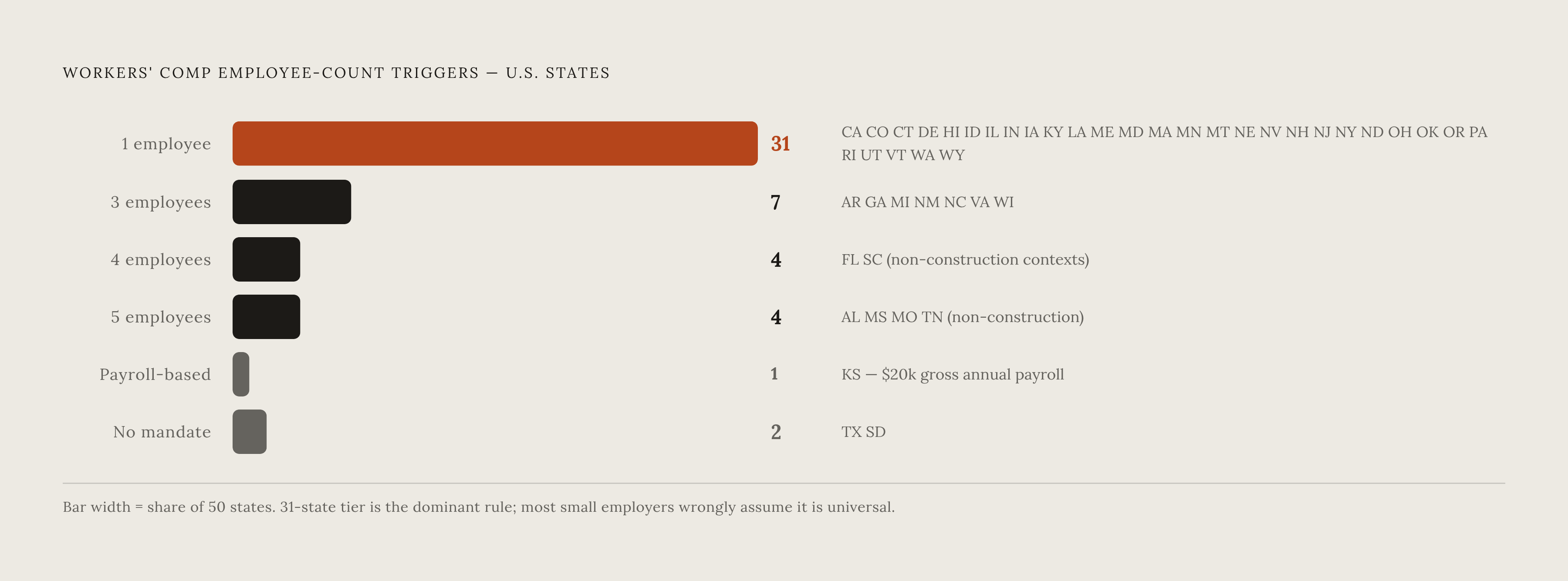
The following thresholds are starting points, subject to exemptions and industry rules. One employee generally triggers coverage in California, Colorado, Connecticut, Delaware, Hawaii, Idaho, Illinois, Indiana, Iowa, Kentucky, Louisiana, Maine, Maryland, Massachusetts, Minnesota, Montana, Nebraska, Nevada, New Hampshire, New Jersey, New York, North Dakota, Ohio, Oklahoma, Oregon, Pennsylvania, Rhode Island, Utah, Vermont, Washington, and Wyoming. California’s requirement appears in Cal. Labor Code §3700, and New York’s in NY WCL §§2–3.
Three employees generally trigger coverage in Arkansas, Georgia, Michigan, New Mexico, North Carolina, Virginia, and Wisconsin. The relevant statutes include Ark. Code §11-9-102, O.C.G.A. §34-9-2, MCL 418.115, NMSA §52-1-6, NCGS §97-2, and Va. Code §65.2-101. Exceptions change that starting point. Arkansas has a lower construction trigger, New Mexico requires coverage for construction at any number, and North Carolina requires it at one employee for radiation work. Wisconsin also has a minimum-wages test in any calendar quarter, while Michigan has the single-worker hours-and-duration test described above.
Businesses generally need coverage once they have four employees if they do non-construction work in Florida under Fla. Stat. §440.02 and non-agricultural businesses in South Carolina under S.C. Code §42-1-360. South Carolina also exempts businesses below a minimum prior-year payroll threshold. Five employees generally trigger coverage in Alabama, Mississippi, and non-construction businesses in Missouri and Tennessee. Their statutes are Ala. Code §25-5-50, Miss. Code §71-3-5, RSMo §287.030, and Tenn. Code §50-6-102. Alabama’s under-five exemption does not apply to builders of new single-family homes, while Tennessee requires coverage for coal mining at one employee.
Kansas uses a different yardstick. Kan. Stat. Ann. §44-501 sets the trigger at gross annual payroll over $20,000, including out-of-state wages, regardless of employee count. Texas and South Dakota have no general private-employer mandate. North Dakota, Ohio, Washington, and Wyoming are monopolistic state-fund states, where a private WC policy does not satisfy the requirement. Agriculture, domestic work, and construction often have different rules within a state, so the state’s WC agency is the verification source.
Why the construction industry carve-out is the sharpest compliance trap for small businesses
Florida’s construction threshold starts at one employee, including the owner, while its general threshold is four employees. That distinction can catch businesses whose names contain neither “builders” nor “construction.” A non-construction business with three employees may have no mandate until it performs construction-related subcontracting work. The work changes the trigger without changing the headcount.
Missouri similarly moves from five employees to one for construction. Tennessee requires construction services providers to have coverage no matter how many employees they have, while contractors and subcontractors in Arkansas need it at a lower employee count. New Mexico requires coverage for licensed construction regardless of employee count.
The business registration is not the deciding document. What workers actually do controls whether the construction rule applies. A landscaping or cleaning company taking a renovation subcontract, or a general services firm doing roofing or HVAC work, can cross that line. The industry code is not a force field.
What non-compliance actually costs — and why the penalty arrives before employers expect it
The penalty clock can start before an employer knows it is running. State penalties commonly accrue daily or per 10-day period from the violation. New York’s compounding structure illustrates that risk, while Alabama assesses penalties per employee per day without coverage.
Florida assesses a penalty equal to twice the owed premium over a defined exposure period, plus a daily penalty for operating under a stop-work order. California adds criminal exposure to the financial cost. Civil penalties can reach hundreds of thousands of dollars, and misdemeanor charges can bring a minimum $10,000 fine and/or up to one year in jail, plus a stop-work order. In Pennsylvania, failing to follow the coverage rules can lead to third-degree felony charges.
A shutdown creates a separate cost. Stop-work orders, common in New York, Florida, and California, halt operations immediately. The revenue lost while the business is forced to stop work can cost more than the fine in the envelope.
The contractor misclassification trap — where WC exposure and 1099 penalties collide
Calling a worker a contractor does not remove that person from the WC count if the state’s test says otherwise. A 1099-NEC is not an invisibility cloak. Workers who do work that is part of the employer’s core business are especially likely to be reclassified as employees. If a misclassified worker is injured, the employer may face personal liability for medical costs and lost wages without an insurer backing the defense.
Federal employment tax liability can stack on top. IRC §3509(a) provides, when 1099s were filed, for liability including 1.5% of wages for income tax withholding, a share of the employee’s Social Security and Medicare obligation, and the full employer FICA match. Under §3509(b), the reduced withholding and employee-share rates double when 1099s were not filed. Intentional misclassification can trigger full taxes, a severe additional penalty, and possible criminal charges.
Section 530 offers a limited employment-tax safe harbor. It requires a reasonable basis for classification, consistent treatment of similar workers, and all required 1099 filings. All three conditions must be met, and employment-tax relief does not settle the separate WC classification question.
How a single remote hire in another state creates a new WC obligation — and what the four monopolistic states mean for multi-state teams
WC follows where an employee works. Most policies can be endorsed for multiple states, but each work state must be specifically listed. An unlisted state leaves a coverage gap. A team with employees in Texas, New York, and Ohio therefore faces optional coverage, a first-employee mandate, and a state-fund requirement at the same time.
The four monopolistic states require separate attention. North Dakota, Ohio, Washington, and Wyoming require state-fund coverage. Ohio also allows self-insurance, but it requires more employees than the small businesses covered here have.
Relocations create another route to a gap. An employee may move, keep working, and tell payroll or HR months later, creating retroactive exposure. A single remote hire also creates payroll tax registration and withholding obligations in the new state, without a minimum payroll safe harbor. Convenience-of-the-employer rules in seven states, with New York enforcing them particularly strictly, can complicate withholding further, but they do not replace the WC analysis based on work location.
The year-end WC audit — what it is, why it adjusts your premium, and what happens if you ignore it
The annual WC audit reconciles the estimated payroll used to price a policy with actual payroll. The result can be a refund or an additional bill. For multi-state employers, it also reconciles payroll across listed states, so incorrect work-location reporting can expose coverage gaps as well as change the premium. Ignoring the audit can trigger a non-compliance charge that is a multiple of the original premium.
The One Big Beautiful Bill Act added fields to the 2026 W-2 where employers must report tips and overtime separately. The Social Security wage base and 401(k) elective deferral limit also increased for 2026. The paperwork shares data, but not a single penalty system.
IRC §§6721 and 6722 create two penalty events for an incorrect W-2, one for the government return and one for the worker’s statement. WC audit charges are separate again. For small employers handling payroll in-house, fourth-quarter preparation for the audit, W-2s, and 1099-NECs concentrates the workload. Planning before year-end gives the business time to reconcile payroll and locations before an adjustment becomes an unwelcome cash-flow surprise.
How to audit your own WC compliance posture before your next hire or state expansion
The practical response is a review built around the next change in the business. Start by mapping where employees actually work, using where remote workers are now even if their original offer-letter addresses differ. Then check each state’s threshold against its WC agency or statute. Pay particular attention to construction exceptions, Kansas’s payroll test, and the four monopolistic state funds.
Next, review who belongs in the count. Count part-time, seasonal, and family workers when state rules say to include them, and use the state’s classification test to check who is a contractor. Then compare those locations with the policy’s listed states and any required state-fund coverage. This is where the headcount review meets the insurance contract.
Finally, set a fresh review trigger for every new-state hire, employee relocation, and change in business activities. A renovation subcontract deserves that check just as much as a new office. For a small team without in-house HR, catching a missing registration or policy gap before payday costs far less than confronting a stop-work order or uninsured injury claim.
This article is sponsored by Fernly.